Hypnotherapy for Teacher Burnout: A Practical Guide
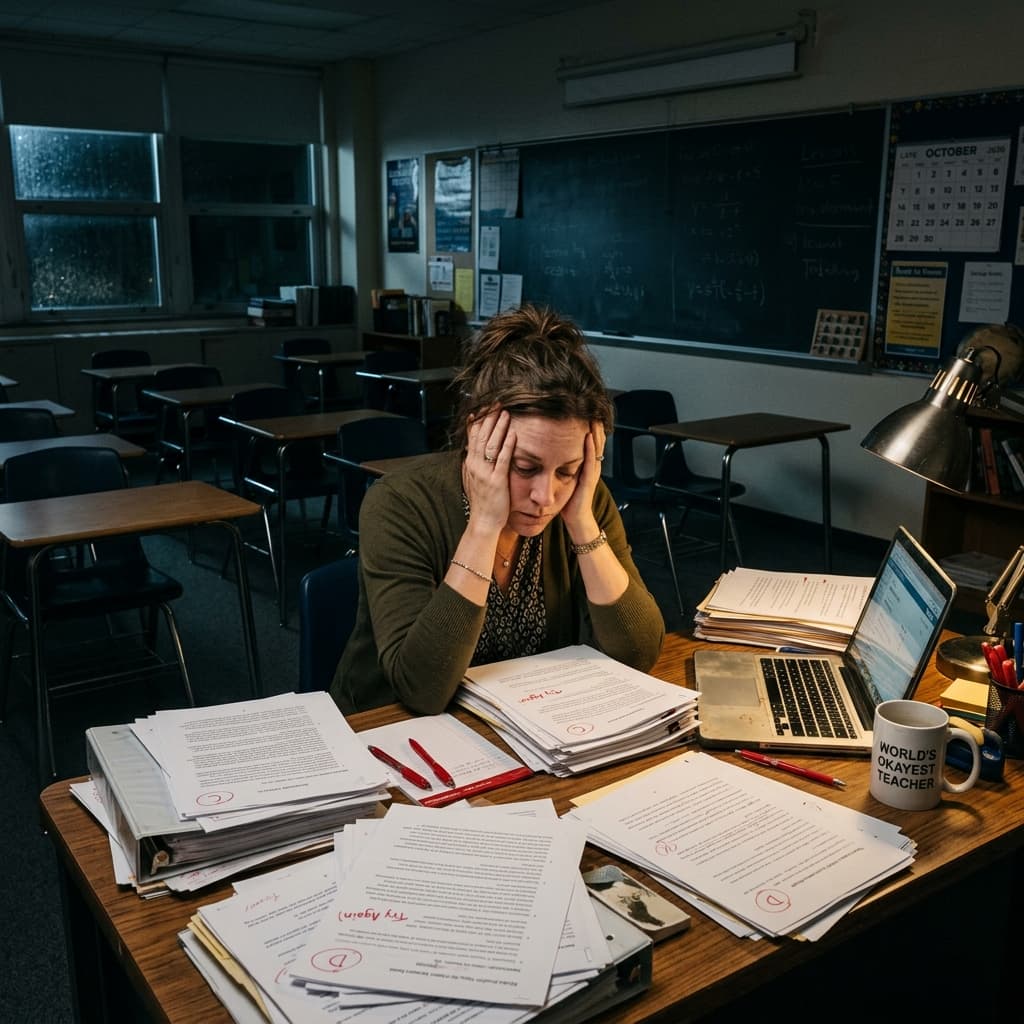
The school day ends, but the teacher brain does not clock out.
There are emails to answer. Behaviour incidents to replay. Lessons to adjust. Parents to respond to. Marking to finish. A staff meeting that somehow created more work than it solved. Then Sunday arrives and the body starts reacting before Monday has even happened.
That pattern is why people search for hypnotherapy for teacher burnout. They are not usually looking for a lecture about self-care. Teachers have heard that speech. The problem is deeper than one more bath, one more planner, or one more breathing exercise between bells.
Teacher burnout often lives in the nervous system: the automatic bracing before class, the guilt when resting, the sense of being constantly observed, the emotional residue from difficult students, and the mental load of caring about work that never feels finished.
This guide explains how teacher burnout can work, where hypnotherapy may fit, what sessions might look like, how it differs from generic stress management, and when stronger mental health or workplace support is the right next step.
Hypnotherapy is a complementary approach. If you're experiencing significant symptoms, depression, panic attacks, trauma responses, thoughts of self-harm, or burnout that affects daily functioning, please consult a qualified healthcare provider.
Why teacher burnout feels different from ordinary work stress
Most jobs have pressure. Teaching has pressure with an audience.
A teacher may be making hundreds of micro-decisions a day while being watched by children, teenagers, colleagues, leaders, and sometimes parents. The work is public, emotional, noisy, interrupted, and full of invisible labour. Even a good lesson can require constant scanning: who is confused, who is escalating, who is disengaged, who needs support, who has disappeared into the back corner of the room.
That makes teacher burnout different from simple tiredness.
It may include:
- Sunday dread before the school week begins
- emotional exhaustion after difficult classes
- irritability that feels out of character
- a heavy body before entering the building
- trouble switching off after school
- replaying classroom moments at night
- guilt about not doing enough for students
- dread around parent emails or complaints
- sensitivity to noise, interruption, or behaviour issues
- loss of confidence in teaching ability
- resentment followed by shame for feeling resentful
- feeling trapped between caring and depletion
The difficult part is that many teachers enter the profession because they care. That care can become the exact lever that burns them out. The mind says, "If I stop, I am failing them." The body says, "I cannot keep doing this." Burnout often begins in the conflict between those two messages.
The loops that keep teacher burnout running
Teacher burnout is rarely one problem. It is usually several loops running together.
The first is the anticipation loop. A difficult class, a demanding parent, or a past behaviour incident can make the body brace before the day starts. The teacher may wake up already rehearsing the worst part of the schedule. By the time school begins, the nervous system has been at work for hours.
The second is the responsibility loop. Teaching can make a person feel responsible for outcomes they cannot fully control: student behaviour, attendance, home circumstances, test results, school policies, administrative demands, and classroom culture. When responsibility exceeds control, the body often converts the gap into anxiety.
The third is the performance loop. Teachers are constantly performing calm, authority, patience, clarity, and enthusiasm. Even when exhausted, they often have to keep a steady face. That emotional performance can become a second job layered on top of the actual teaching.
The fourth is the recovery guilt loop. Rest should restore energy. For burned-out teachers, rest can trigger guilt. There is always planning, marking, reporting, or preparation that could be done. The body is off duty, but the internal taskmaster keeps taking attendance.
Hypnotherapy may support burnout by working with these automatic loops rather than only adding conscious advice on top of them.
How hypnotherapy may help with teacher burnout
Hypnotherapy uses a focused, receptive state to work with mental imagery, emotional patterns, body responses, and rehearsed behaviours. For teacher burnout, the goal is not to make someone tolerate an unhealthy workload indefinitely. That would be a terrible use of therapy and, frankly, a very school-system thing to ask of a human being.
The better goal is to help the nervous system recover its range.
A hypnotherapist may help a teacher practise:
- entering the classroom without automatic bracing
- separating personal worth from student behaviour
- releasing the emotional residue of a difficult day
- reducing Sunday-night dread
- rehearsing calmer responses to conflict
- setting boundaries without a wave of guilt
- switching from teacher mode into home mode
- rebuilding confidence after criticism or complaint
- sleeping without replaying the timetable
- responding to workload pressure with more choice and less panic
Some practitioners use Ericksonian hypnotherapy, which relies on indirect suggestion, metaphor, and client-led imagery. Others may combine hypnosis with parts work, future pacing, nervous-system regulation, habit rehearsal, or cognitive-behavioural strategies. The exact method matters less than whether the practitioner understands that burnout is not laziness. It is a system under strain.
What a session might look like
A first session usually begins with mapping the pattern. A practitioner may ask about the school week, the most difficult points of the day, specific triggers, sleep, workload, emotional exhaustion, and what the teacher wants to feel instead.
For teacher burnout, the useful details are often very specific.
Not just "work is stressful," but:
- the stomach drop on Sunday afternoon
- the dread before Period 5
- the parent email that keeps replaying
- the staffroom conversation that tipped the day over
- the student behaviour that activated old helplessness
- the moment after school when the body should relax but cannot
- the guilt that appears when laptop stays closed
Once the pattern is clear, hypnosis may be used to create a calm, focused state. The practitioner might guide the client through imagery of leaving work at work, placing mental boundaries around unfinished tasks, rehearsing a difficult class with more steadiness, or reconnecting with the parts of teaching that still feel meaningful.
A session might also include an anchor: a simple physical cue, phrase, or breath pattern linked to steadier state. The teacher can then practise using that cue before walking into class, opening email, starting marking, or driving home.
Future pacing is also common. Instead of waiting for Monday morning and hoping for the best, the mind rehearses a more regulated response in advance. The aim is not fantasy. It is nervous-system practice.
Why boundaries matter in teacher burnout work
No amount of hypnosis should be used to make an impossible workload feel fine.
That line matters.
Hypnotherapy may help a teacher respond differently to stress, but it should not become a way to quietly absorb broken systems. If workload, bullying, unsafe classrooms, harassment, discrimination, or chronic understaffing are central to the burnout, practical workplace action may be necessary too.
That can include talking to a union representative, trusted leader, doctor, therapist, employee assistance program, or legal/workplace advisor depending on the situation.
The best hypnotherapy work supports agency. It helps someone notice where the body is stuck in automatic fear, guilt, or over-functioning, then practise a different response. Sometimes that response is calmer teaching. Sometimes it is a clearer boundary. Sometimes it is taking leave. Sometimes it is leaving the school.
The goal is not endless resilience. The goal is choice.
Teacher burnout, sleep, and Sunday dread
Sleep is one of the most common places teacher burnout shows up.
A teacher may fall asleep exhausted, then wake at 3am thinking about lesson plans, student welfare, classroom management, or something a parent said. Sunday sleep can be especially difficult because the mind reads Monday as a threat to prepare for.
Hypnotherapy for sleep-related burnout may focus on the transition between work mode and rest mode. A practitioner might use guided imagery to close the day, suggestion to reduce mental rehearsal, or a pre-sleep routine that gives the subconscious a repeated signal: the planning window is closed.
This overlaps with broader hypnotherapy for insomnia, but teacher burnout has its own texture. The issue is often not only sleep hygiene. It is the sense that vigilance is responsible. The mind believes it must keep working so nothing falls apart.
A useful session may help the teacher separate genuine preparation from anxious rehearsal. Planning a lesson is useful. Mentally teaching the lesson twelve times in bed is usually not.
Teacher burnout and boundaries with parents, students, and school demands
Boundary-setting can be especially hard for teachers because the work is relational. Saying no may feel like letting a student down. Not answering email at night may feel irresponsible. Leaving work unfinished may trigger shame.
Hypnotherapy may help by rehearsing boundary moments before they happen.
For example:
- reading an email without immediately absorbing its emotional tone
- pausing before agreeing to another task
- ending a work session without guilt
- responding to criticism without collapsing into self-blame
- holding a calm internal state during a difficult conversation
- letting a student’s bad day remain separate from personal worth
This connects closely with hypnotherapy for boundary setting and hypnotherapy for people pleasing. Many burned-out teachers are not short on skill. They are over-trained in responsibility.
How long might it take?
There is no universal timeline for teacher burnout because the causes vary.
Some people use a short course of three to six sessions to work on a specific pattern such as Sunday dread, classroom anxiety, sleep disruption, or guilt around boundaries. Others need longer support, especially if burnout overlaps with trauma, depression, grief, workplace conflict, or major career decisions.
A practical plan might look like this:
- Session 1: map the burnout pattern, identify triggers, set goals, and practise an initial regulation strategy
- Session 2: work with the strongest automatic response, such as Sunday dread or classroom bracing
- Session 3: rehearse boundaries, recovery routines, and after-school decompression
- Session 4 and beyond: address deeper confidence, past incidents, career decisions, or long-running emotional exhaustion
The right practitioner should be comfortable discussing progress. If nothing is shifting after several sessions, it is reasonable to reassess the approach or seek additional support.
When hypnotherapy may not be enough
Hypnotherapy can be one helpful support, but it is not the right standalone answer for every situation.
Consider medical, psychological, or urgent support if burnout includes:
- thoughts of self-harm
- severe depression or hopelessness
- panic attacks that feel unmanageable
- trauma symptoms after classroom violence or serious incidents
- inability to sleep for extended periods
- substance use to cope with work
- feeling unsafe at school
- workplace bullying or harassment
- emotional exhaustion that makes daily functioning difficult
A hypnotherapist should not discourage appropriate healthcare, therapy, workplace advocacy, or crisis support. Good complementary care knows its lane.
How to choose a hypnotherapist for teacher burnout
When choosing a practitioner, look for someone who speaks about burnout with nuance. The right person will not frame the problem as weak mindset. They will understand nervous-system load, boundaries, emotional labour, and the difference between personal coping skills and systemic pressure.
Useful questions to ask:
- Have you worked with burnout, educators, workplace stress, or compassion fatigue?
- How do you approach Sunday dread or anticipatory anxiety?
- Do you include tools for between sessions?
- How do you handle burnout that is linked to workplace conditions?
- What would make you recommend additional mental health support?
- How many sessions do you usually suggest before reviewing progress?
You can start by searching for a qualified practitioner through Find a Hypnotherapist, or compare local and remote options if your schedule makes in-person appointments difficult. Online sessions may be especially useful for teachers who need support outside school hours or during term time.
Related guides that may help include hypnotherapy for burnout, hypnotherapy for healthcare worker burnout, hypnotherapy for anxiety, and online hypnotherapy.
The real aim: not becoming a better machine
Teacher burnout is often discussed as if the teacher simply needs better coping skills.
Sometimes coping skills help. But the deeper issue is that many teachers have been trained to override their own signals for too long. Keep going. Smile. Adjust. Absorb. Differentiate. Document. Stay calm. Do more with less. Then feel guilty for being tired.
Hypnotherapy may help some teachers interrupt that automatic override. Not by making them superhuman, but by helping the body remember that rest is not misconduct, boundaries are not cruelty, and a difficult school system does not get to define a person’s worth.
The best outcome is not a teacher who can endure anything.
The best outcome is a teacher who can hear their own nervous system again and make clearer choices from there.
Looking for a qualified hypnotherapist?
Browse our directory of verified professionals to find the right match for your needs.
Search Directory